

Bra shopping is already enough of a guessing game without a cup somehow looking too big and too small at the same time. Yet that is exactly what can happen with bell-shaped breasts: the bottom of your bra cup feels completely filled out while the top has that annoying little pocket of space. You go down a cup size, and suddenly the bottom feels crowded, or you tighten the straps until the cup sits closer and spend the rest of the day adjusting them. If that sounds familiar, the problem may be the shape of the cup rather than the size alone.
How To Tell If Your Breasts Are Bell Shaped
Bell-shaped breasts are slimmer toward the top and fuller toward the bottom. They can look similar to teardrop breasts, although teardrop shapes tend to stay a little rounder through the upper breast.
You do not have to match a breast-shape diagram exactly. All bodies are different, and there can be overlap between shapes. What you are looking for is a noticeable difference between the amount of fullness above and below the nipple.
At A Glance
| If You Are Dealing With | Start With | What To Check |
|---|---|---|
| Gaping at the top under T-shirts | Molded full-coverage | Enough depth in the lower cup and a neckline that sits close to the breast |
| Molded cups that keep looking hollow | Unlined full-coverage | Fabric that follows your shape instead of holding a fixed foam mold |
| More forward projection than you want under clothes | Minimizer | Full coverage without creating side spill or uncomfortable compression |
| Wanting to skip underwire | Structured wireless | A stable band and defined cup shape rather than stretchy fabric alone |
Why Gaping Happens Even When The Cup Is Not Too Big
Cup size describes volume, but two bras with the same size on the tag can distribute that volume differently.
A bell-shaped breast generally needs more room through the lower part of the cup. If a bra is shallow at the bottom and more open through the top, the lower breast can fill the available space while the neckline still stands away from the body.
Sizing down may close that gap, but squeeze the lower breast or create spillover somewhere else.
Molded bras make this especially easy to see because the cup holds its own shape. I love a T-shirt bra for the smooth finish, but a thin T-shirt is ruthless about showing a fit problem. That ridge or hollow spot along the neckline can become much more obvious once you put a shirt over it.
Check The Band And Cup Before You Keep Adjusting The Straps
Straps are usually the first thing I blame when a bra starts annoying me. They slide down my shoulder, dig in, or seem like they need to be tightened again, so the obvious assumption is that I have a strap problem.
If you keep shortening them to pull the top of the cup closer to your body, you may be compensating for a band or cup that is not sitting correctly.
If tighter straps are the only thing making the upper cup lie flat, look at the band first. It should sit level around your torso rather than riding higher in the back, and it should feel snug enough to stay in place when you raise your arms without feeling painfully tight. If the band is creeping upward or shifting around, the straps can end up doing more work than they should.
Full Coverage Is The Best Place To Start
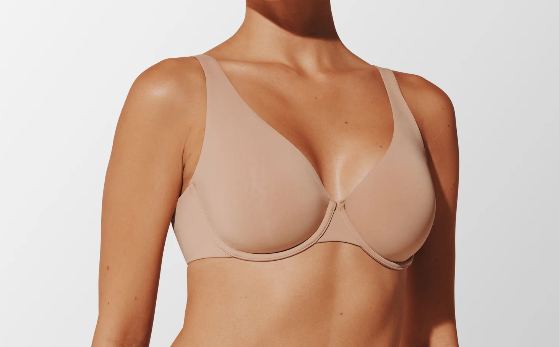
A full-coverage bra gives you more cup around the breast than a demi or balconette, which can help if lower-coverage styles tend to cut in or spill. For everyday wear, molded full coverage is especially appealing under T-shirts, fitted sweaters, or thinner knits. The molded cup can give you that smoother finish under clothing without dropping the coverage.
The T-shirt test is one of the easiest ways to judge the fit. Put on the kind of shirt you would normally wear and turn sideways. Look at the neckline of the bra through the fabric. A molded cup that fits closely can almost disappear. One that stands away from the upper breast usually becomes much easier to spot.
One bra that fits this general mold is Thirdlove’s 24/7 Classic Perfect Coverage. It has the fuller cup shape I’m talking about, plus underwire and padded straps.
Molded cups do have one limitation: the foam already has a shape of its own. If your upper breast does not fill that shape closely, the cup can stay standing away from the body even if the lower portion fits well.
If Molded Cups Keep Gaping, Try An Unlined Cup
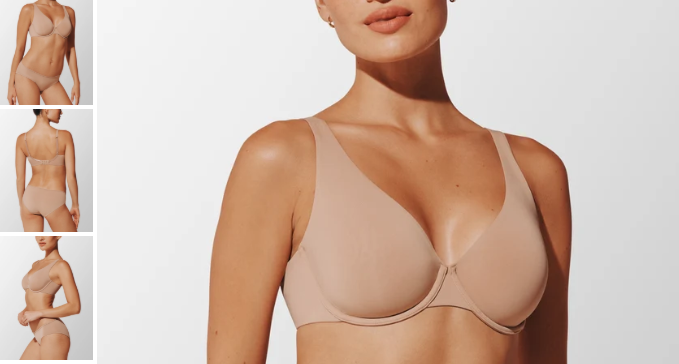
An unlined full-coverage bra approaches the same fit problem differently. Without a preformed foam cup holding its own shape, the fabric has more freedom to follow the breast.
Thirdlove’s 24/7 Classic Second Skin Unlined is the kind of bra I mean here. It keeps a fuller-coverage shape but uses an unlined cup, which may work better if molded bras consistently leave space near the top.
There is a tradeoff under very thin clothing. You may see more natural breast shape, texture, or nipple outline, so I would still reach for a molded bra first when I specifically want that very smooth T-shirt finish.
There is also a sizing issue that can get mistaken for a cup-shape problem. Sometimes one standard cup feels slightly crowded, and the next full size leaves more space than you need. This is one place where Thirdlove’s half-cup sizing is helpful. If you keep ending up between “slightly too small” and “slightly too big,” having that in-between size gives you another option.
A Minimizer Can Help With Projection Under Clothes

You can have a bra that fits your bell shape correctly and still want your bust to sit a little differently under certain clothes.
Button-down shirts are an obvious example. Everything can be contained inside the cup while the buttons still pull more than you would like. The same thing can happen with fitted blazers or dresses where even a small change in projection changes how the garment hangs.
A minimizer redistributes some of that projection, so check the fit from the front as well as the side. Flattening the profile is not much of a win if the bra pushes breast tissue far enough outward that you suddenly have uncomfortable pressure or visible bulging near the sides of the cup. This is more of a clothing and silhouette decision than a requirement for the breast shape itself.
Wireless Bras Still Need Enough Structure
A soft stretch bralette and a wireless bra with defined cups, a substantial band, and adjustable straps can feel completely different once you put them on.
If the entire bra stretches freely in every direction, a fuller lower breast may settle lower or move outward as the day goes on. That may be exactly what you want from a lounge bra, but it can be frustrating if you expected the same lift or separation you get from a more structured bra.
Look for some definition through the cups and enough stability through the band to keep the bra in place. Wider or adjustable straps can make the bra more comfortable, but they should not be the only part creating lift.
I would also try the wireless bra under an actual outfit before deciding. The shape you like for a Sunday afternoon at home may not be the shape you want under a fitted top.
You Can Still Wear Balconettes And Plunge Bras
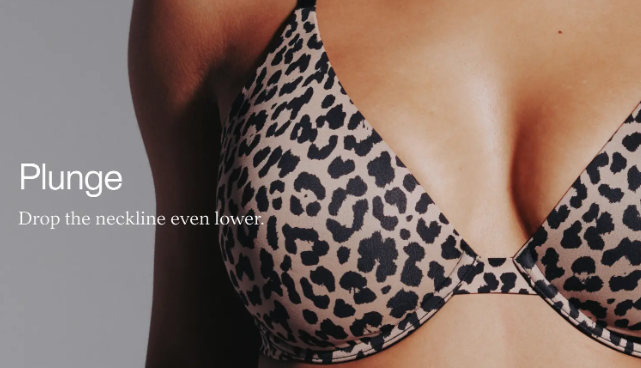
I have always thought balconettes are beautiful, so I would never treat “bell-shaped” as a rule that means you are limited to high-coverage bras forever.
Lower-coverage styles are simply less forgiving if most of your fullness sits lower in the cup. The edge of a balconette or demi bra may hit closer to the fuller part of the breast, which can create overflow if that particular cup is too shallow.
Pay more attention to the individual cup than the style name. A balconette with generous depth through the bottom can fit very differently from another one that looks almost identical on a hanger.
Use the same cup-depth check with a plunge. If the lower part of the breast has enough room and the neckline stays clean against the body, the lower neckline itself is not automatically the problem.
If you have to size up just to stop spillover and then the upper portion becomes loose, try another cut rather than assuming balconettes or plunges are off the table.
Before You Return A Bra, Check These Things
- Settle all of your breast tissue into the cups first. The fit can change once everything is positioned properly.
- Check that the band stays level. Raise your arms and make sure it is not climbing up your back.
- Look closely at the lower cup. Extra space at the top does not automatically mean the whole cup is too large if the bottom is already full.
- Check the sides and any underwire. Breast tissue should stay inside the cup rather than slipping underneath the wire or escaping toward the armpit.
- Adjust the straps after the band and cups are in place. They should stay on your shoulders without digging or pulling the cup upward.
- Put your shirt back on. If you are shopping for a T-shirt bra, an actual T-shirt is a better test than staring at the bra by itself.
You do not need a perfectly textbook “bell-shaped” fit to use any of this. If the lower cup feels good, the top lies smoothly, and you are not spending the day fixing your straps, you are probably headed in the right direction.